

 Festival
Ethical guidelines
How we hold the space on every Journey: consent, intimacy, power, and what we do when something goes wrong.
Last updated 11.11.2026Our stance
Why this page exists
Expand creates spaces where touch, intimacy and sexuality can happen. Spaces like these need clear values, written down where everyone can read them before they arrive.
These guidelines describe how we see consent, intimacy and power, and how we want to live them together.
They grow out of sovereignty, one of our pillars: each of us is the authority over our own body, our own choices and our own pace.
What we write here is not a final truth that solves every problem. We don't have all the answers, and we get things wrong too. We believe these topics can only move forward together, as a community, through clear and open conversations. That's why this page will keep evolving over time.
Tinka & Alp
Diversity
Room for every body
We want Expand to feel welcoming to people of every gender, sexual orientation, ethnicity, age and body.
Spaces like ours tend to be dominated by white cisgender bodies, and we are working to change that. Being the only one, or one of very few, in a group can make a space feel less safe. When that happens, we offer optional invitations to name it to the group and to find ways together of bringing more safety to that person. We support beings from under-represented minorities in finding their place with us.
We deliberately don't balance our groups by gender. We don't want to create a comfortable setup where every man is met by a woman. Instead, we welcome what an imbalance can bring: the chance to learn something about ourselves that a perfectly matched group would never show us. For the same reason, we don't share statistics about our groups, such as gender or age ratios.
Shared responsibility
Held together
Many of the sections below ask each of us to take care of ourselves: to say No, to ask, to name our boundaries. That matters, but it is only half of the picture. Responsibility is always shared.
- Hosts and facilitators carry as much responsibility for the space as the participants in it.
- Between participants, every interaction is a shared responsibility.
- When something goes wrong, the responsibility is shared too.
- Even when we should have said No and didn't, the others involved share responsibility, whether that's another participant or a facilitator.
Accepting risk
With responsibility comes risk. Sometimes we make mistakes and get things wrong. Sometimes we don't say No when we should, we don't ask for support when we need it, or we cross our own boundaries. Even stepping out of bed is taking a risk. Entering a Journey is one too. We name this openly, and we choose to enter the experience knowingly.
Consent
Nothing is ever required
Consent isn't something we agree to once at the door. We practise it in every moment, with every person, in every space.
- Every practice, every invitation and every touch is our own choice, including when the invitation comes from a facilitator.
- We can say No, take a break, stay undecided or change our mind at any time. No is never the wrong answer.
- We ask before we touch, and we listen to the answer, spoken or not. When in doubt, we ask again.
- Each workshop and each Temple names its own invitations and boundaries before it begins.
We give others the same freedom we want for ourselves, and we thank them when they use it.
Nudity & intimacy
Welcomed, and always optional
Nudity, sensuality and sexual interaction can be part of an Expand Journey. They are never expected, and they are never a measure of how deep someone goes.
- Nudity and sexual interaction are never required. Spending a whole Journey fully clothed and without sexual practice is just as welcome.
- At the Festival, nudity and sexuality only happen inside the experience spaces, such as workshops and Temples. Never in the open air or in shared areas.
- We respect the agreements each person brings with them, including those of couples and of people who live monogamously.
Power dynamics
A no guru culture
Hosts, facilitators and artists hold roles that carry trust, and we take that seriously. Our facilitators are guides, not gurus. We do not feed into a culture where our space holders are seen as better than others.
We are wary of any setting where one person becomes the source of truth for everyone else. That is where abuse of power often begins, and we actively work against it:
- During an Expand Journey, facilitators and participants have no sexual interactions with each other whatsoever. This includes physical and energetic interaction. What counts as sexual can vary from person to person, so we invite everyone not to look for the edge where sensual becomes sexual, and to stay well clear of it.
- The only exception is a connection that already exists before the Journey, such as partners or lovers. We name these connections to the group in advance, so that any intimacy between them happens openly.
- Participants may reach out to a facilitator for non-sexual interaction, to explore their own topics and the projections a facilitator can bring up in them. When that happens, we talk clearly and openly about the power dynamics that are or may be present, and how they can support or get in the way of the interaction.
- Power dynamics don't disappear the moment a Journey is over. That's why we discourage intimate interactions between facilitators and participants after a Journey too. Where they do happen, we ask for clear communication and for these dynamics to be named openly.
- A role that holds power makes No harder to say, even when nobody intends it. We name this openly, during a Journey and in connections outside it, and we want to hear about it whenever it happens.
- We also look at why power gets abused in the first place. Forbidding abuse is not enough on its own. Within the team, we hold a supportive container for awareness and transparency, so we can meet our own shadows, bring them to light, and find healthier ways to move the energy that needs moving.
Our facilitators make mistakes, just like everyone else. They are not perfect, and they are likely to get some things wrong during a Journey too. Everyone is accountable for their mistakes, facilitators included, but we don't hold anyone to a standard of perfection.
When something goes wrong
Support and repair
When many people explore intimacy together, boundaries will sometimes be crossed, by mistake or otherwise. We would rather say this openly than pretend it can't happen. What matters is what we do next.
During a Journey
Our facilitators are always there for support, and we can reach out to any of them. In workshops, exercises and Temples, some of them are clearly named as support angels. We can go to them at any moment, with something small or something serious.
Any time, also after a Journey
We can also reach out through an online form, during or after a Journey, also weeks or months later. It goes to the hosts of the Journey.
If the concern is about the hosts or a facilitator, we can turn to an independent third party instead: (coming soon).
The limits of support
Not all of our facilitators are therapists. They support us as far as their capacity allows, and when something needs more than that, they help us look for the right support.
How we invite resolution
- 1
We listen
Whoever reaches out is heard first, without having to prove anything.
- 2
We ask what is needed
We ask the person what they need, and find out together how they want to go on.
- 3
We meet and talk
We invite everyone involved to meet and talk, with mediation if that helps.
- 4
The community holds the space
We invite the community to step in and hold a container where everyone involved can find resolution and heal. This is open to all sides, whether someone was hurt or caused hurt, because everyone involved needs a process that supports their growth. The community holds it without judgement, only with love and care.
Every step is an invitation, and nothing is forced. We only go into the processes that feel right for those involved. We also accept that sometimes resolution isn't possible, or not right away, and that's okay too.
What we are building
An independent review of this process is in preparation for the Festival. We will describe it here once it is in place.
Each Journey lists its own agreements on its page, because they differ between formats. That way the agreements sit right next to the ticket, and nobody has to leave an event page to read them.
Questions about these guidelines? Write to us, or meet us in the community.

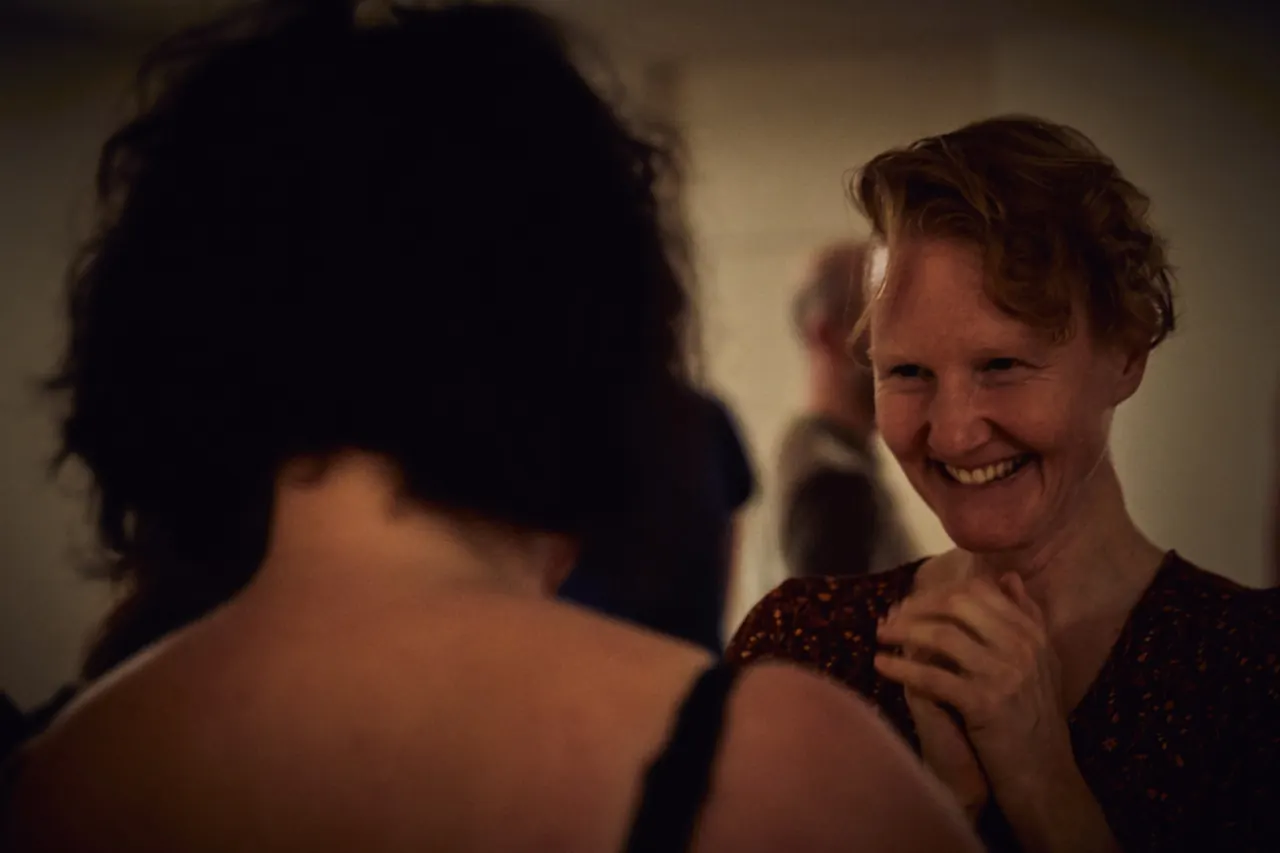
Photo: Djamila Grossman
Join the community
New dates and Early Bird openings reach the community first.
Get in touch
If you have any questions or feedback, feel free to contact us and let us know.
Prefer Instagram? Send us a message at @expand.journey.
We use your details only to reply to you. How we handle your data.